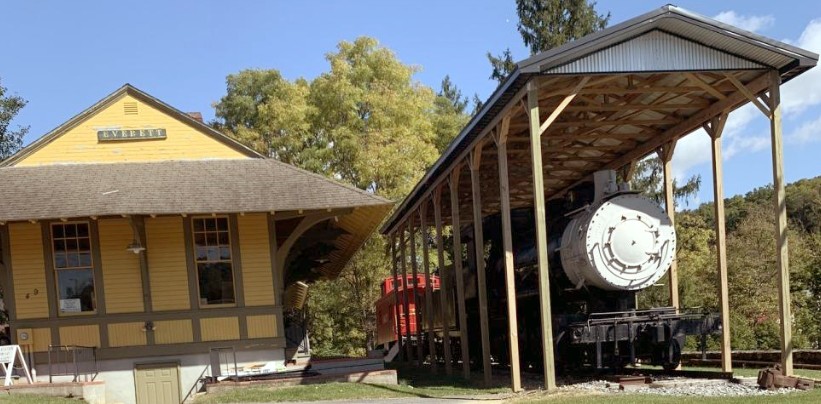
Everett, PA.
1885 - The Everett Glass Factory was founded.
Profiles


Bedford County Press — February 29, 1968
75 Years Ago in Glass House:
Eight-year-old Earned 5 Cents An Hour, Went to School Nights
A class room and a teacher donated his services to tutor the young glass workers at night. So they worked from 7 a. m. to 5 p. m. in the glass house, then went to school from 7 to 9 p. m. Their wages: 5 cents an hour, 45 cents a day!
Mr. Kinkead recalls that the glass works, long since out of existence, had its own version of the “company store.” The treasurer of the company, he relates, owned a hardware store, where the family of the young workers would go to pick up a sack on the grocery store or butcher shop of their choice. When buying groceries or meats, the purchase price was entered in the book by the merchant. On payday, the costs were taken out of the employee’s pay. If there was anything left over, the employee got a little cash.
“Incidentally,” recalls Mr. Kinkead, “my brother and I received many an empty envelope. It was all used up.”
Mr. Kinkead explains that the reason the children could leave the glass house to go to school five nights weekly was due to the fact that the plant had a pot furnace, so there was no night work.
The cart in the lower right hand corner of the accompanying photo, Mr. Kinkead says, was the “blowers’ lunch wagon.” A number of the blowers boarded at a hotel, which would send over hot lunches to them in the wagon.
“When the blowers finished eating,” Mr. Kinkead recalls, “us boys saw to it that nothing was wasted.”
Mr. Kinkead became an apprentice in 1902 and became a member of the GBBA when he moved to Bellaire, Ohio, in 1906. He later worked at glass plants in Toronto and Montreal, Canada, Millville, N. J., Calumet, Pa., and Marienville, Pa., before moving to Lancaster, N. Y., in 1922, where he was a member of Local 37. He served as financial secretary of local unions in various cities where he worked and was a delegate to the GBBA convention in Rochester, N. Y., in 1914. Thirty years later, he was again a delegate to the Cleveland convention, representing Local 37. He retired in 1955 after 62 years in glass bottle plants.
Note: The article’s headline says “75 Years Ago,” referring to approximately 1893, which corresponds with the Everett Glass Company workforce photograph you shared earlier. The article also provides valuable information about child labor, wages, evening schooling, and working conditions in Everett’s glass industry.